What's working
What's working reads the results of your own posts and tells you which times, lengths, first lines and kinds of post go with better results than usual, and how sure it is. It is for deciding what to do more of. Nothing on the page changes a post or a schedule.
Open What's working in the sidebar, under Measure. Anyone who can see the brand can read it.
What it needs
Findings are worked out once a day, from posts that have been out for a week and whose results the network reports. Until there are some, the page says Nothing learned yet. Post on a connected account and come back in a week or two.
A new brand will see mostly Too few posts at first. That is the page being honest, not a fault.
Read a finding
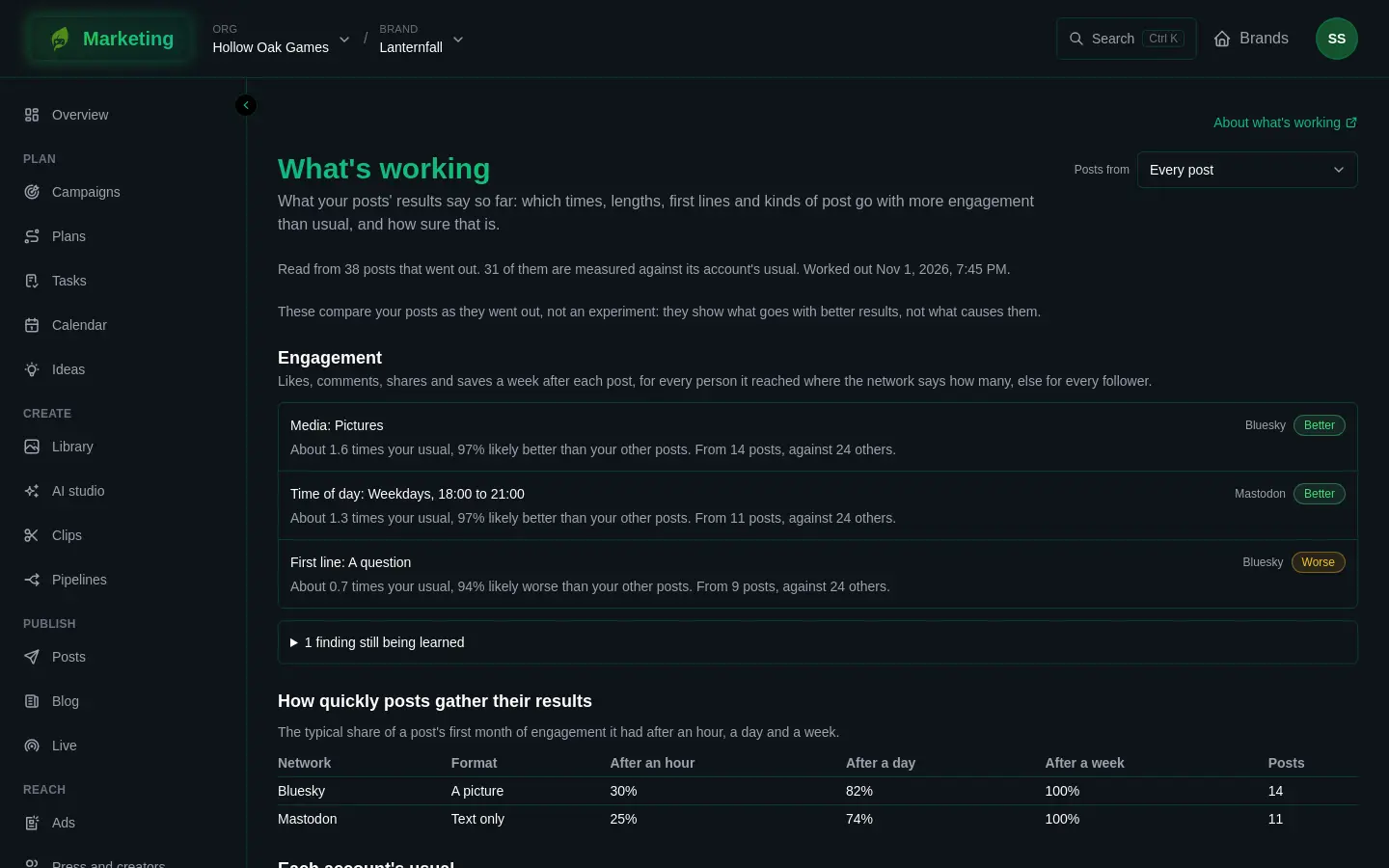
A finding is one thing about a post, such as Time of day: Weekdays, 18:00 to 21:00, First line: A question or Format: A short vertical video, with the network it was seen on. It is judged against the same account's other posts on that network.
Each finding has a badge:
- Better: posts like this did better than the rest, and the page is fairly sure.
- Worse: they did worse.
- Not clear yet: they look different, but not by enough to trust.
- Too few posts: it is waiting for more posts on each side before it says anything, and tells you how many.
The line under it reads like this: About 1.4 times your usual, 85% likely better than your other posts. From 9 posts, against 31 others. "Your usual" is explained under Each account's usual, below. The percentage is how likely the difference is real rather than luck.
Findings are grouped by what was measured:
- Engagement: likes, comments, shares and saves a week after each post, for every person it reached where the network says how many, and otherwise for every follower.
- Clicks on your links: clicks on a post's tracked links in its first week, for posts that carry one. See Links.
Only the clear ones are listed. Open the line findings still being learned to see the rest.
What it looks at
Each post is described by when it went out (in your audience's own time, on weekdays or weekends), the day of the week, how its first line reads, its length, how many hashtags it has, where it came from, its format, its media, whether a video has captions and how long it is, whether the media was made with AI, whether it carries a link, how it went out, whether it fell on a public holiday, and whether it was around one of the brand's events.
Where it came from is Written by a person, A clip cut by hand, or what made it, such as a pipeline. Once the brand has pipelines, Posts from appears: choose one to look at that pipeline's posts only, or Every post to put them all back.
How sure to be
These findings compare posts as they went out. They show what goes with better results, not what causes them. A question may do well because you ask questions on your best days. If you want to know what a change does, an experiment can tell you.
Experiments
If a pipeline is running an experiment, an Experiments section appears. Each post of the pipeline gets one of the variations the experiment tries, more often those doing better. Because who gets which is left to chance, a clear result here does say what the variation does. Each variation shows Today's setting, Better, Worse, Not clear yet or Learning. See Pipeline experiments.
Each account's usual
Each account's usual gives, for every account and format, the middle result of its latest posts a week after they went out. A post is measured against this number, so a small account and a big one read alike.
How quickly posts gather their results
The table How quickly posts gather their results shows, for each network and format, the typical share of a post's first month of engagement it had after an hour, a day and a week. Use it to know how early you can judge a post.
Where your audience is
Where your audience is lists the countries and time zones the brand's audience is mostly in. It is counted from clicks on your tracked links and the countries your stores and sites report. Until it is known, times are read in UTC.
The page ends with the countries whose public holidays it counts.
If it goes wrong
If the page stays empty, check that posts went out through a connected account and that the account's numbers are being read; see Number problems.